Wordflow Temporal Course · Optional exercises
Extra · Pick First
Goal: the dictionary has two regions, and each is slow at random. Ask both, use whichever answers first, and cancel the other.
Concepts
Run in parallel, take the first. Start several Activities without waiting, then wait for whichever finishes first.
Cancel the rest. Cancel the scope the other Activities were started in. The Workflow records the cancel request and moves on.
Activities learn about cancellation from heartbeats. A running Activity is just your code on a Worker. It only finds out it was cancelled when it sends a heartbeat and the reply says so. Then its context is cancelled, which also aborts its HTTP request. Activities that should stop early must heartbeat and have a heartbeat timeout.
This changes running games. The guess handler now produces different commands. Wrap the change in a version check, as in Lesson 13.
Patterns
What you’ll build
- The dictionary service takes
?region=NAMEand adds 0–1.5 s of random latency. - A
LookupWordInActivity that sends the region and heartbeats while it waits. isRealWordFastest: start a lookup ineastandwest, wait for the first, cancel the other.- A
race-dictionaryversion check that chooses between the old single lookup and the race.
Build it
The dictionary service already supports ?region=NAME.
1. Input
Add to app/shared/extras.go:
// Extra: Pick First.
type LookupInput struct {
	Word   string `json:"word"`
	Region string `json:"region"`
}
2. A region-aware Activity
In app/activities/dictionary.go, rename the body of LookupWord to a private lookup that takes a region, then add LookupWordIn. Import "go.temporal.io/sdk/activity" and "wordflow/app/shared":
func (a *DictionaryActivities) LookupWord(ctx context.Context, word string) (bool, error) {
	return a.lookup(ctx, word, "")
}

// LookupWordIn asks one region of the dictionary. Canceling ctx abandons the
// request.
func (a *DictionaryActivities) LookupWordIn(ctx context.Context, input shared.LookupInput) (bool, error) {
	// A running Activity learns it was canceled from a heartbeat response.
	done := make(chan struct{})
	defer close(done)
	go func() {
		ticker := time.NewTicker(200 * time.Millisecond)
		defer ticker.Stop()
		for {
			select {
			case <-ticker.C:
				activity.RecordHeartbeat(ctx)
			case <-done:
				return
			}
		}
	}()
	return a.lookup(ctx, input.Word, input.Region)
}

func (a *DictionaryActivities) lookup(ctx context.Context, word, region string) (bool, error) {
	u := a.BaseURL + "/words/" + url.PathEscape(word)
	if region != "" {
		u += "?region=" + url.QueryEscape(region)
	}
	req, err := http.NewRequestWithContext(ctx, http.MethodGet, u, nil)
	// ... the rest of the old LookupWord, unchanged
}
Goroutines are fine in Activities. Only Workflow code has restrictions. The SDK throttles heartbeats, so calling RecordHeartbeat often is cheap.
3. Race the regions
Create app/workflows/pickfirst.go:
package workflows

import (
	"time"

	"go.temporal.io/sdk/temporal"
	"go.temporal.io/sdk/workflow"

	"wordflow/app/activities"
	"wordflow/app/shared"
	"wordflow/internal/game"
)

var dictionaryRegions = []string{"east", "west"}

// checkDictionary chooses how to look a word up. Games that started before
// the race existed keep making a single lookup.
func checkDictionary(ctx workflow.Context, word string) bool {
	if workflow.GetVersion(ctx, "race-dictionary", workflow.DefaultVersion, 1) == workflow.DefaultVersion {
		return isRealWord(ctx, word)
	}
	return isRealWordFastest(ctx, word)
}

// isRealWordFastest asks every region at once, takes the first answer, and
// cancels the rest.
func isRealWordFastest(ctx workflow.Context, word string) bool {
	ctx, cancel := workflow.WithCancel(ctx)
	defer cancel()

	var a *activities.DictionaryActivities
	selector := workflow.NewSelector(ctx)
	var valid bool
	var err error
	for _, region := range dictionaryRegions {
		regionCtx := workflow.WithActivityOptions(ctx, workflow.ActivityOptions{
			Summary:                "lookup in " + region,
			StartToCloseTimeout:    2 * time.Second,
			ScheduleToCloseTimeout: 10 * time.Second,
			HeartbeatTimeout:       time.Second,
			RetryPolicy: &temporal.RetryPolicy{
				InitialInterval:    500 * time.Millisecond,
				BackoffCoefficient: 2,
				MaximumAttempts:    5,
			},
		})
		future := workflow.ExecuteActivity(regionCtx, a.LookupWordIn, shared.LookupInput{Word: game.Normalize(word), Region: region})
		selector.AddFuture(future, func(f workflow.Future) {
			err = f.Get(ctx, &valid)
		})
	}
	selector.Select(ctx)

	if err != nil {
		workflow.GetLogger(ctx).Warn("dictionary lookup failed", "word", word, "error", err)
		return false
	}
	return valid
}workflow.Selectoris the Workflow-safeselect.Selectruns the callback of the first Future that’s ready.defer cancel()cancels the losing Activity when the function returns.GetVersioncan be called inside a handler. It only runs when a guess needs a lookup, which is deterministic.- The slice gives a fixed order. Ranging over a map here would not be deterministic.
In the guess handler in game.go, call checkDictionary instead of isRealWord:
if outcome == game.OutcomeNotInPuzzle && checkDictionary(ctx, guess.Word) && !state.Over() {4. Run it
Restart the Worker.
Check it
-
Start a new game and guess a few bonus words. They’re still marked as bonuses.
-
The server log shows both regions for each word: one answers, and the other logs caller gave up a moment later.
-
The game’s history shows two
ActivityTaskScheduledevents labelled lookup in east and lookup in west, one completed, andActivityTaskCancelRequestedfor the other.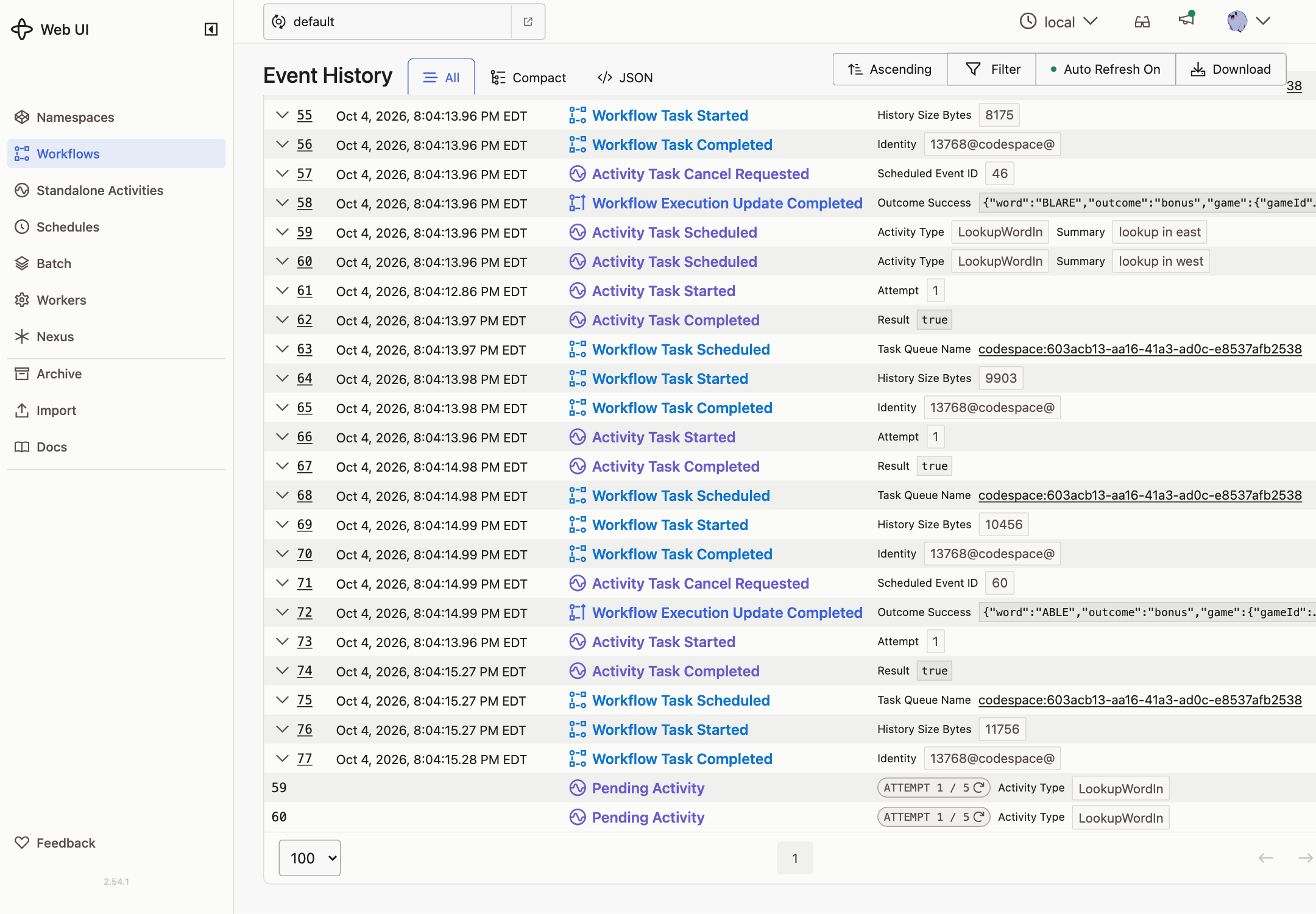
-
A game that started before the change still makes one lookup per word.