Wordflow Temporal Course · Lessons
08 · Workflow to Workflow
Goal: hints. The first two are free. After that, each costs a player 10 points, paid by the Player Workflow.
Concepts
Workflows can’t call the Client. A Client call is a network call, so it isn’t deterministic. To send a message to another Workflow, a Workflow runs an Activity, and the Activity uses a Client. The Worker gives the Activity its Client when it starts. That’s dependency injection, the same as the puzzle store in Lesson 2.
Errors that mean “no”. When the Player rejects a payment (not enough points), the Activity gets an application error. Retrying won’t change the answer, so the Activity makes it non-retryable.
Idempotency across Workflows. An Activity can run more than once. For example, a Worker crash after the Update succeeded but before the result was recorded causes a retry. If each attempt sent a new Update, the player could pay twice. Instead, the Update ID is derived from the hint request’s own Update ID. Every retry of the same hint sends the same Update ID, and the Player de-duplicates it.
Handlers interleave. While the hint handler waits for its Activity, other handlers run. A guess could finish the game in the middle of a hint. A Workflow mutex makes the handlers that touch the game take turns. After getting the lock, re-check the rules: the validator ran before the wait.
Patterns
What you’ll build
- A
spendPointsUpdate onPlayerWorkflow. Its validator checks the game is the player’s active game and that the player has enough points. - A
SpendPointsActivity that sends that Update with a Client, using the Update ID it’s given. - A
hintUpdate onGameWorkflow: lock, re-check, pay if it’s not free, reveal a letter. - The
guesshandler takes the same lock. UseHintin the API sends thehintUpdate.
Build it
1. Names and types
In app/shared/shared.go, add UpdateHint = "hint" to the Game names and UpdateSpendPoints = "spendPoints" to the Player names. Then add:
type SpendPointsInput struct {
	GameID string `json:"gameId"`
	Amount int    `json:"amount"`
}

type SpendPointsResult struct {
	Remaining int `json:"remaining"`
}

type SpendPointsActivityInput struct {
	PlayerID string `json:"playerId"`
	GameID   string `json:"gameId"`
	Amount   int    `json:"amount"`
	UpdateID string `json:"updateId"`
}
2. The Player accepts payments
In app/workflows/player.go, after the startGame handler:
	err = workflow.SetUpdateHandlerWithOptions(ctx, shared.UpdateSpendPoints,
		func(ctx workflow.Context, input shared.SpendPointsInput) (shared.SpendPointsResult, error) {
			player.Spend(input.Amount)
			return shared.SpendPointsResult{Remaining: player.Points}, nil
		},
		workflow.UpdateHandlerOptions{
			Validator: func(ctx workflow.Context, input shared.SpendPointsInput) error {
				return player.CheckSpend(input.GameID, input.Amount)
			},
		},
	)
	if err != nil {
		return err
	}
3. An Activity with a Client
Create app/activities/players.go:
package activities

import (
	"context"
	"errors"

	"go.temporal.io/sdk/client"
	"go.temporal.io/sdk/temporal"

	"wordflow/app/shared"
)

// PlayerActivities send messages to Player Workflows using a Temporal Client.
type PlayerActivities struct {
	Client client.Client
}

// SpendPoints asks a Player Workflow to spend points.
func (a *PlayerActivities) SpendPoints(ctx context.Context, input shared.SpendPointsActivityInput) (shared.SpendPointsResult, error) {
	handle, err := a.Client.UpdateWorkflow(ctx, client.UpdateWorkflowOptions{
		WorkflowID:   shared.PlayerWorkflowID(input.PlayerID),
		UpdateID:     input.UpdateID,
		UpdateName:   shared.UpdateSpendPoints,
		Args:         []any{shared.SpendPointsInput{GameID: input.GameID, Amount: input.Amount}},
		WaitForStage: client.WorkflowUpdateStageCompleted,
	})
	var result shared.SpendPointsResult
	if err == nil {
		err = handle.Get(ctx, &result)
	}

	var appErr *temporal.ApplicationError
	if errors.As(err, &appErr) {
		// The Player said no. Asking again will get the same answer.
		return result, temporal.NewNonRetryableApplicationError(appErr.Message(), appErr.Type(), err)
	}
	return result, err
}
The Activity uses the same API as your HTTP code. Network errors stay retryable.
Register it in app/cmd/worker/main.go, passing the Worker’s Client:
w.RegisterActivity(&activities.PlayerActivities{Client: c})4. The hint Update
In app/workflows/game.go, create a mutex after var state *game.State:
	// Handlers that block (on an Activity) take this lock so they run one at a time.
	lock := workflow.NewMutex(ctx)
At the top of the guess handler, take it:
			if err := lock.Lock(ctx); err != nil {
				return game.GuessResult{}, err
			}
			defer lock.Unlock()
Register hint with the other handlers:
	err = workflow.SetUpdateHandlerWithOptions(ctx, shared.UpdateHint,
		func(ctx workflow.Context) (game.HintResult, error) {
			if err := lock.Lock(ctx); err != nil {
				return game.HintResult{}, err
			}
			defer lock.Unlock()

			// The game may have changed while this handler waited for the lock.
			if err := state.CheckHint(); err != nil {
				return game.HintResult{}, err
			}
			cost := state.NextHintCost()
			if cost > 0 {
				if err := spendPoints(ctx, state, cost); err != nil {
					return game.HintResult{}, err
				}
			}
			if err := state.RevealLetter(workflow.Now(ctx)); err != nil {
				return game.HintResult{}, err
			}
			return game.HintResult{PointsSpent: cost, Game: state.View()}, nil
		},
		workflow.UpdateHandlerOptions{
			Validator: func(ctx workflow.Context) error {
				if err := checkLoaded(state); err != nil {
					return err
				}
				return state.CheckHint()
			},
		},
	)
	if err != nil {
		return game.Result{}, err
	}
Add the helper:
// spendPoints asks the player's Workflow to pay for a hint.
func spendPoints(ctx workflow.Context, state *game.State, amount int) error {
	ctx = workflow.WithActivityOptions(ctx, workflow.ActivityOptions{
		StartToCloseTimeout: 10 * time.Second,
	})
	input := shared.SpendPointsActivityInput{
		PlayerID: state.PlayerID,
		GameID:   state.GameID,
		Amount:   amount,
		// Same hint request, same Update ID: a retried Activity cannot charge twice.
		UpdateID: state.GameID + "-hint-" + workflow.GetCurrentUpdateInfo(ctx).ID,
	}
	var a *activities.PlayerActivities
	return workflow.ExecuteActivity(ctx, a.SpendPoints, input).Get(ctx, nil)
}workflow.Mutexis safe in Workflow code.sync.Mutexis not.GetCurrentUpdateInfo(ctx).IDis the ID of thehintUpdate being handled: the API’s request ID.- The guest check is in
CheckHint, so guests never reachspendPoints.
5. The API
func (a *API) UseHint(ctx context.Context, req httpapi.GameRequest) (game.HintResult, error) {
	handle, err := a.Temporal.UpdateWorkflow(ctx, client.UpdateWorkflowOptions{
		WorkflowID:   req.GameID,
		UpdateID:     req.RequestID,
		UpdateName:   shared.UpdateHint,
		WaitForStage: client.WorkflowUpdateStageCompleted,
	})
	if err != nil {
		return game.HintResult{}, err
	}
	var result game.HintResult
	err = handle.Get(ctx, &result)
	return result, err
}
6. Run it
make clean-workflowsRestart the Worker and the server. Compare with solutions/08.
Check it
Run make clean-workflows, restart the Worker and the server, and join again.
-
Click Hint twice. Each reveals a letter and costs nothing.
-
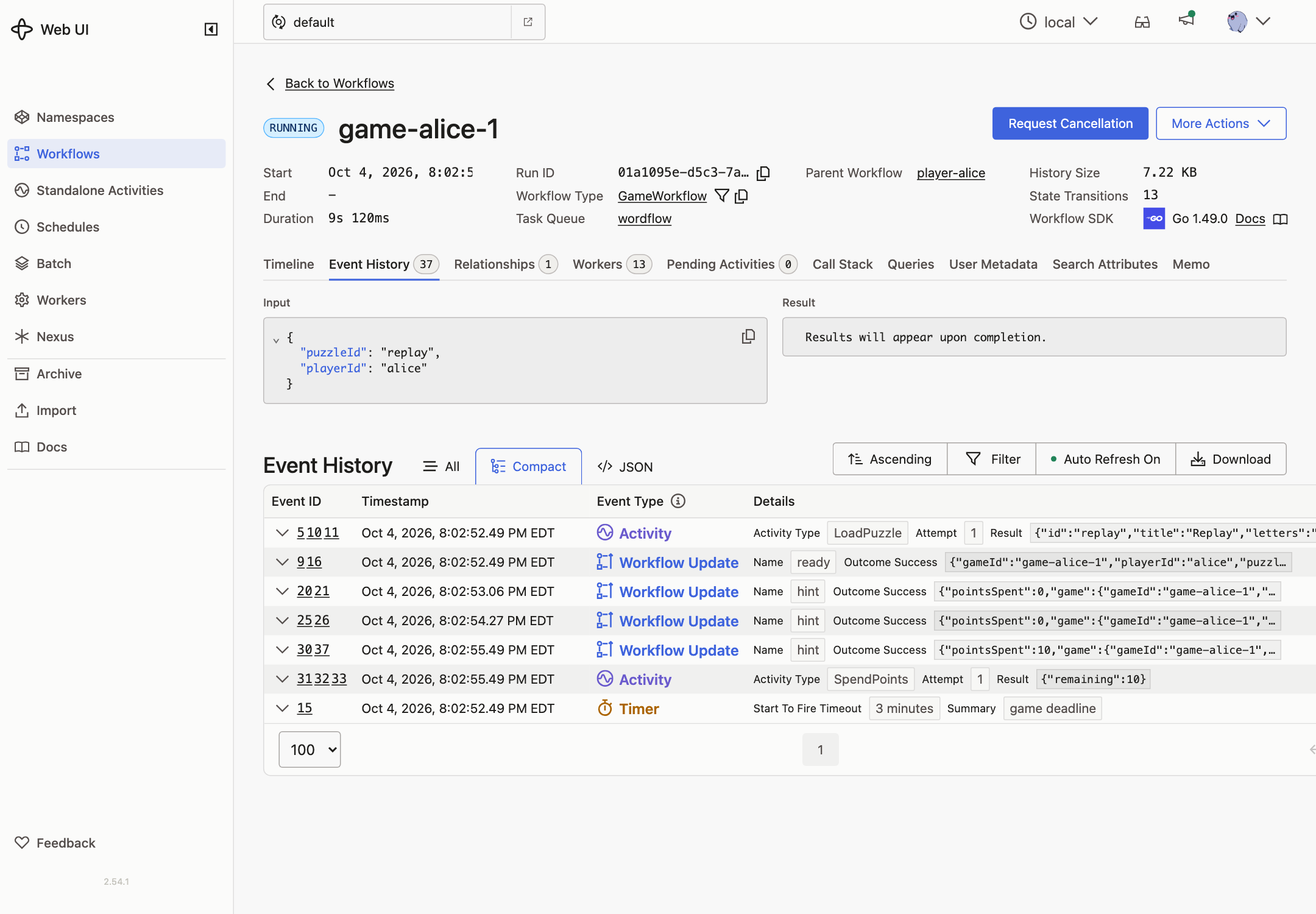
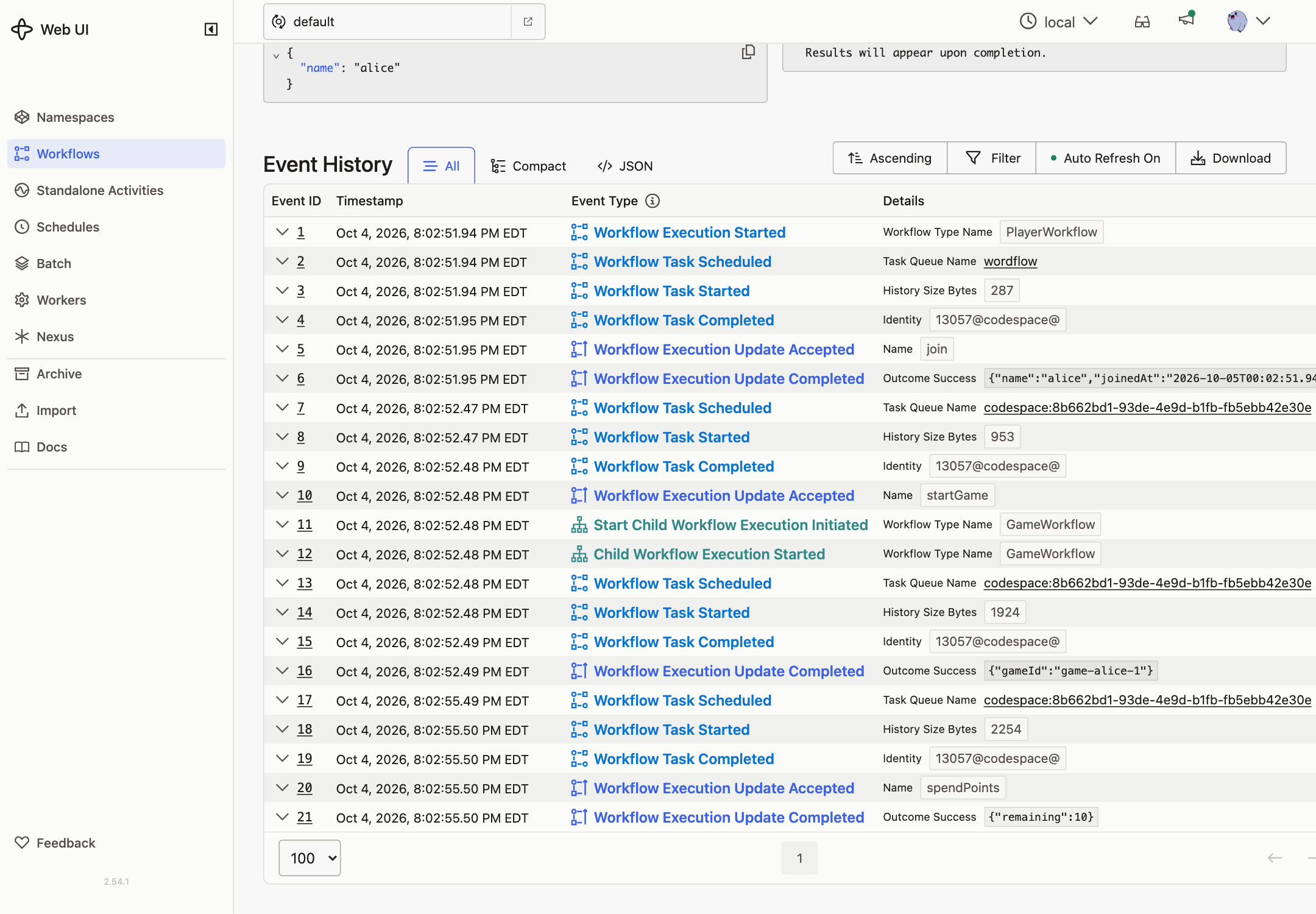
Click Hint again. It reveals a letter and the player panel drops by 10 points. The game’s history has a
SpendPointsActivity.player-alicehas aspendPointsUpdate with an ID ending in-hint-<hint Update ID>.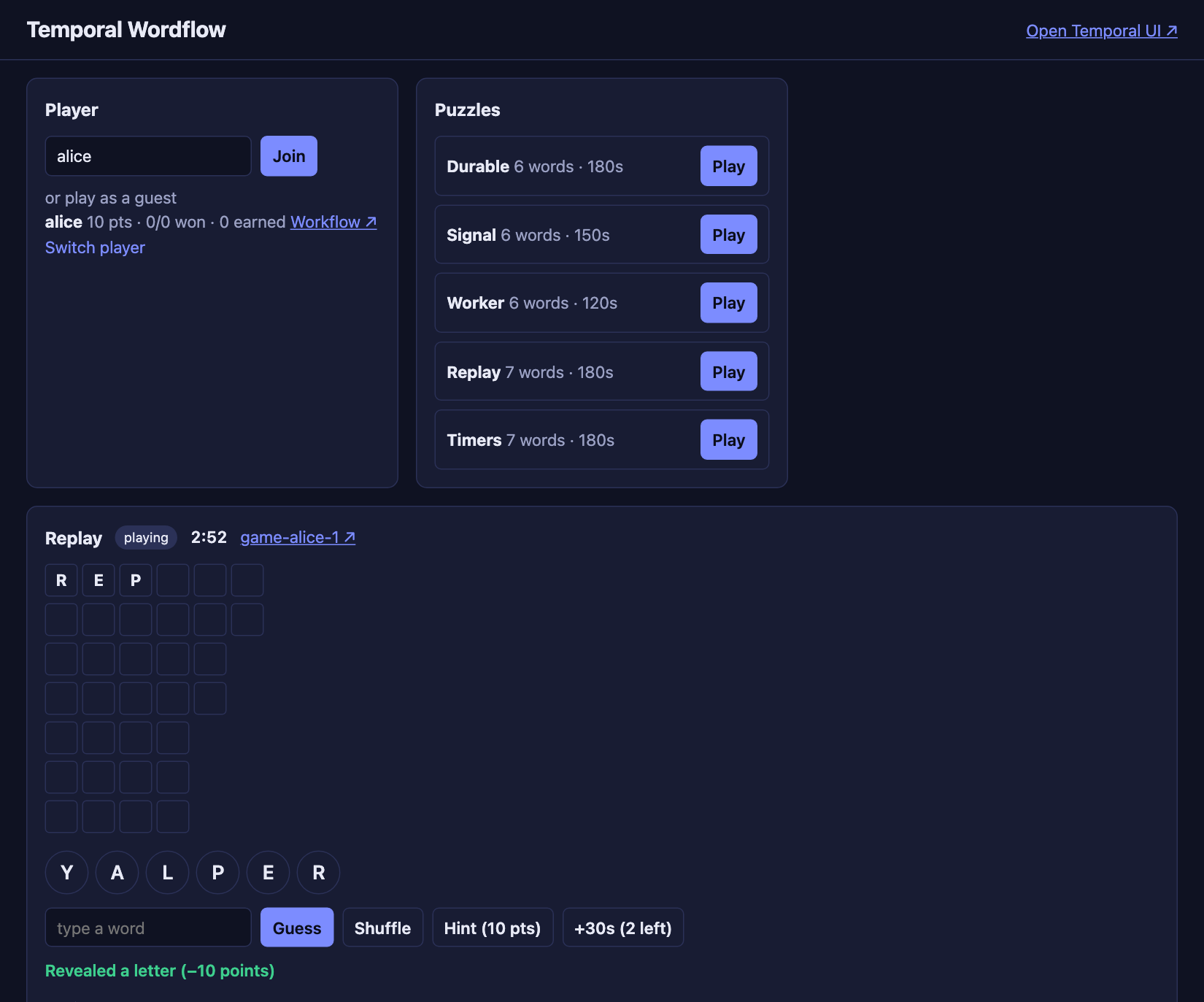
-
Keep buying hints until you have fewer than 10 points. You get not enough points. The
SpendPointsActivity failed after one attempt, and no letter was revealed. -
As a guest, the third hint says guests only get 2 free hints, and no Activity runs.
Think about it
The lock stops a guess from ending the game mid-hint, but the clock doesn’t take the lock. If the game times out while SpendPoints runs, the player has paid and the reveal fails. Two Workflows can’t change state in one step. The Saga exercise shows how to undo a step when a later one fails.