Wordflow Temporal Course · Lessons
02 · Activities
Goal: the Workflow loads its own puzzle, so the API only passes a puzzle ID.
Concepts
Activity. A normal function for work that touches the outside world: files, databases, HTTP calls. Workflows can’t do this work directly because it isn’t deterministic. A Workflow asks for an Activity to run. A Worker runs it, and the result is recorded in the Event History. When the Workflow is re-run, it reads the recorded result instead of calling the Activity again.
Timeouts. Every Activity needs a Start-To-Close timeout: the longest one attempt may take. If an attempt runs longer, it fails and Temporal retries it.
Retries. Failed Activities are retried automatically. The default policy retries forever, waiting 1 s, then 2 s, 4 s, and so on, up to 100 s between attempts. Retries don’t add events to the history. You see one ActivityTaskStarted event that records the final attempt number.
Non-retryable errors. Some failures will never succeed on retry. Asking for a puzzle that doesn’t exist is one. Mark these errors non-retryable and the Activity fails at once.
Dependencies. Activities get their dependencies, such as the puzzle store, when the Worker starts. Workflows never touch them.
Patterns
- Non-Retryable Errors
- Activity Dependency Injection (first look; Lesson 8 goes further)
What you’ll build
- A
LoadPuzzleActivity that reads from the puzzle store. A missing puzzle is a non-retryable error. GameWorkflowtakes{puzzleId}and callsLoadPuzzlewith a 5-second Start-To-Close timeout.- The Worker registers the Activity with a puzzle store.
StartGamepasses the puzzle ID instead of the puzzle.
Build it
1. The Activity
Create app/activities/puzzles.go:
// Package activities holds code that talks to the outside world.
package activities

import (
	"context"
	"errors"

	"go.temporal.io/sdk/temporal"

	"wordflow/internal/game"
	"wordflow/internal/puzzles"
)

// PuzzleActivities gets its dependencies when the Worker starts.
type PuzzleActivities struct {
	Store *puzzles.Store
}

func (a *PuzzleActivities) LoadPuzzle(ctx context.Context, puzzleID string) (game.Puzzle, error) {
	puzzle, err := a.Store.Get(puzzleID)
	if errors.Is(err, puzzles.ErrNotFound) {
		return game.Puzzle{}, temporal.NewNonRetryableApplicationError("no puzzle named "+puzzleID, "puzzle_not_found", err)
	}
	return puzzle, err
}- Activities are plain Go. They take a normal
context.Context. - Methods on a struct are a simple way to give Activities their dependencies. The Activity type name is the method name,
LoadPuzzle. - Any other error is retryable. An application error has a message and a type, and both show up in the Temporal UI.
2. Pass an ID, not a puzzle
In app/shared/shared.go, change the input. You can also remove the internal/game import, since nothing else uses it yet:
type GameInput struct {
	PuzzleID string `json:"puzzleId"`
}
3. Call the Activity from the Workflow
Replace app/workflows/game.go:
package workflows

import (
	"time"

	"go.temporal.io/sdk/workflow"

	"wordflow/app/activities"
	"wordflow/app/shared"
	"wordflow/internal/game"
)

// GameWorkflow loads a puzzle and returns the first view of a new game.
func GameWorkflow(ctx workflow.Context, input shared.GameInput) (game.View, error) {
	gameID := workflow.GetInfo(ctx).WorkflowExecution.ID

	puzzle, err := loadPuzzle(ctx, input.PuzzleID)
	if err != nil {
		return game.View{}, err
	}

	state := game.NewState(gameID, "", puzzle, workflow.Now(ctx))
	return state.View(), nil
}

func loadPuzzle(ctx workflow.Context, puzzleID string) (game.Puzzle, error) {
	ctx = workflow.WithActivityOptions(ctx, workflow.ActivityOptions{
		StartToCloseTimeout: 5 * time.Second,
	})
	var a *activities.PuzzleActivities
	var puzzle game.Puzzle
	err := workflow.ExecuteActivity(ctx, a.LoadPuzzle, puzzleID).Get(ctx, &puzzle)
	return puzzle, err
}WithActivityOptionsreturns a context that carries the timeout and retry policy.var a *activities.PuzzleActivitiesis a nil pointer. It is only used so thata.LoadPuzzlegives the Activity’s name and type checking. The real struct lives in the Worker.ExecuteActivityreturns a Future.Getwaits for the result.- Returning the error fails the Workflow. Because the Activity error is non-retryable, that happens on the first attempt.
4. Register the Activity
In app/cmd/worker/main.go, after RegisterWorkflow:
w.RegisterActivity(&activities.PuzzleActivities{Store: puzzles.NewStore()})Add imports for "wordflow/app/activities" and "wordflow/internal/puzzles". Registering a struct registers each of its exported methods as an Activity.
5. Update the API
In StartGame, delete the a.Puzzles.Get call and pass the ID:
run, err := a.Temporal.ExecuteWorkflow(ctx, options, workflows.GameWorkflow, shared.GameInput{PuzzleID: req.PuzzleID})6. Run it
Restart the Worker and the server. Compare with solutions/02.
Check it
-
Starting a game works as before.
-
In the Temporal UI, the Workflow’s input is
{"puzzleId": "..."}, with no answers. -
The history has
ActivityTaskScheduled,ActivityTaskStarted, andActivityTaskCompletedforLoadPuzzle. The puzzle is in the completed event’s result. -
Restart the Worker with
PUZZLES_FAIL_FIRST=2 make worker. The puzzle store now fails its first two reads. Start a game. It takes about 3 seconds: a 1 s wait, then a 2 s wait, then success. -
Open that Workflow.
ActivityTaskStartedshowsattempt: 3, and there is still only one of each Activity event. Click the Activity to see the last failure.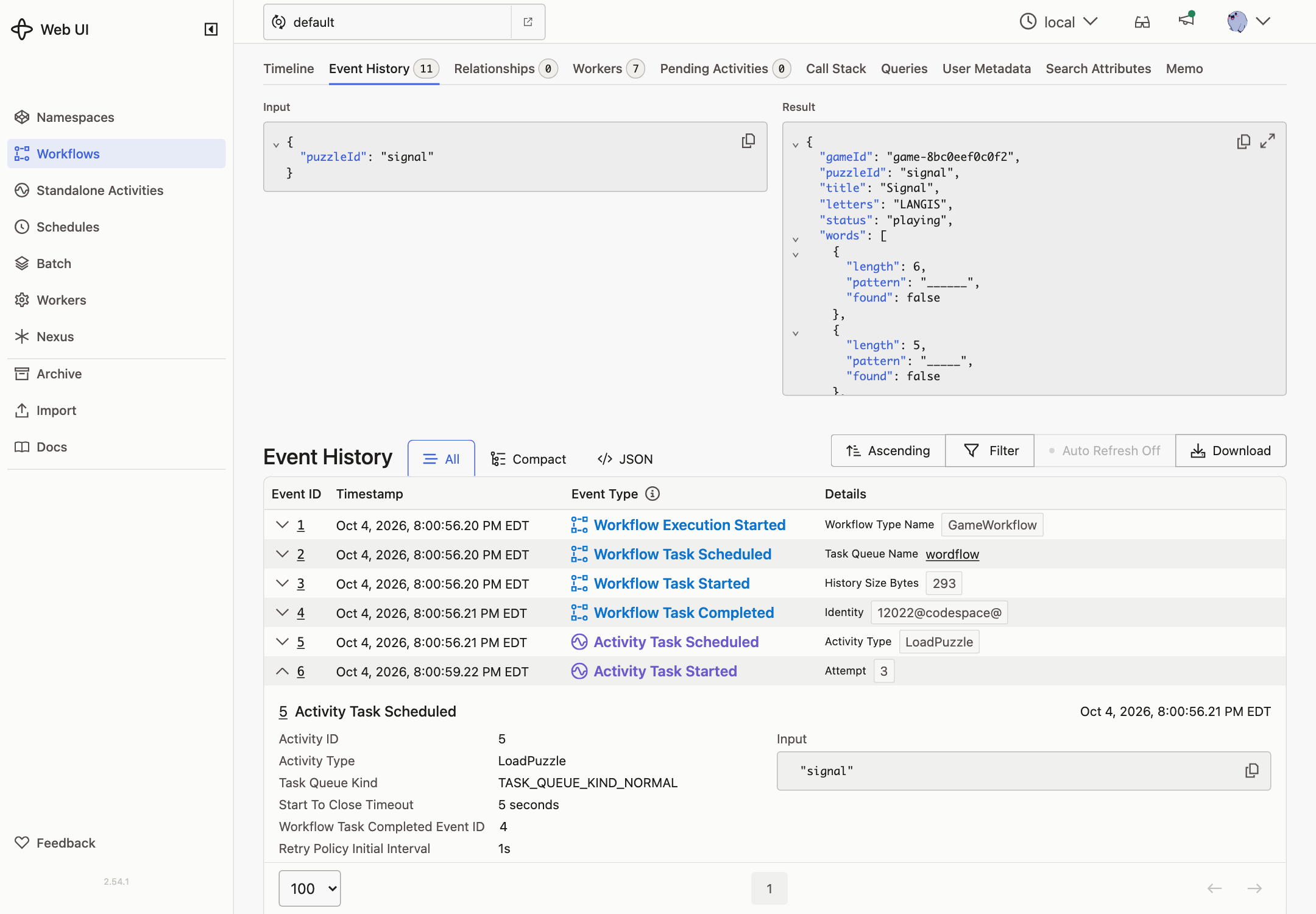
-
Start a Workflow for a puzzle that doesn’t exist (the API checks for this, so use the CLI):
temporal workflow start --type GameWorkflow --task-queue wordflow \
  --workflow-id bad-puzzle --input '{"puzzleId":"nope"}'
It fails at once with
no puzzle named nope, after one attempt.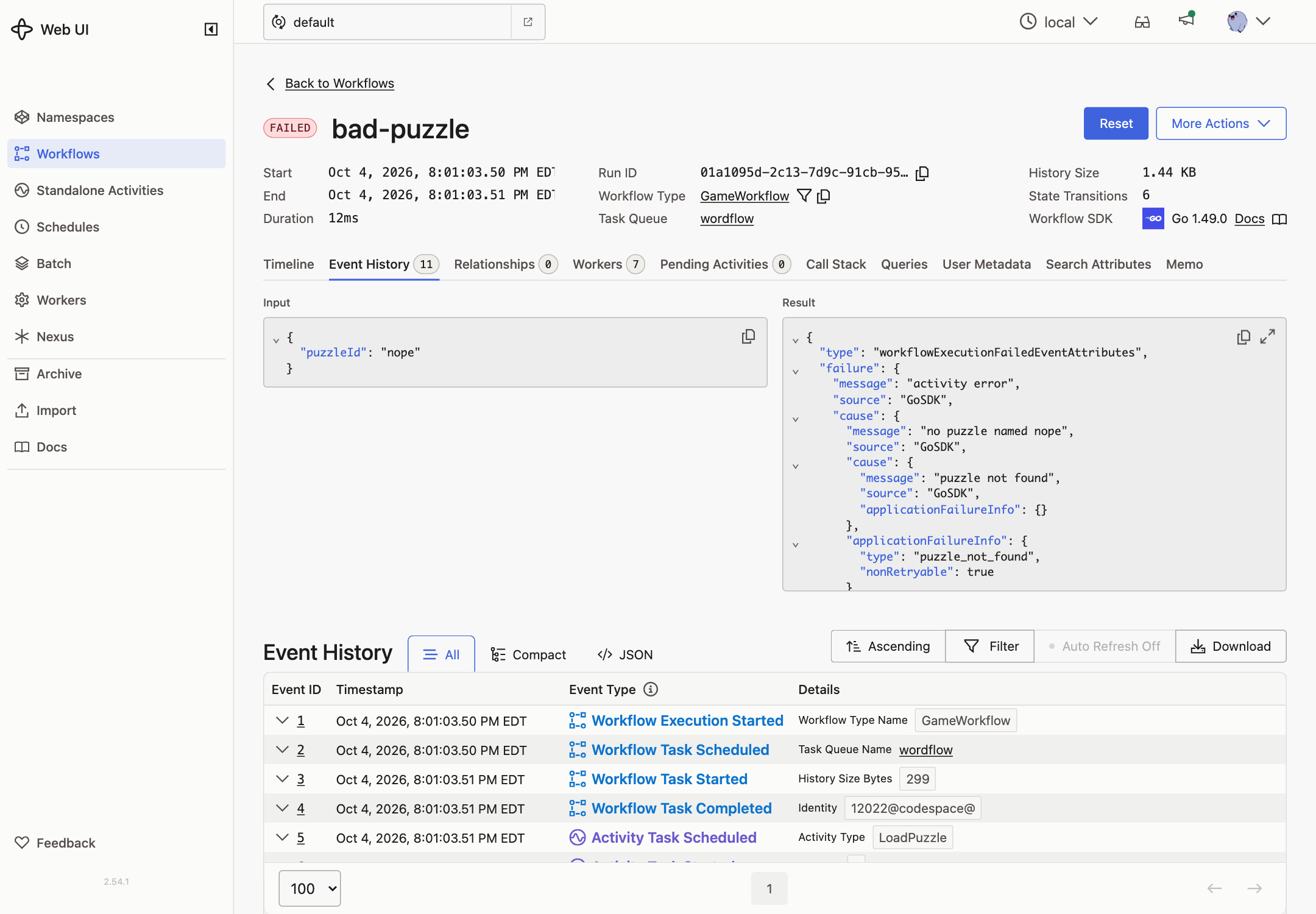
Restart the Worker with plain make worker when you’re done.